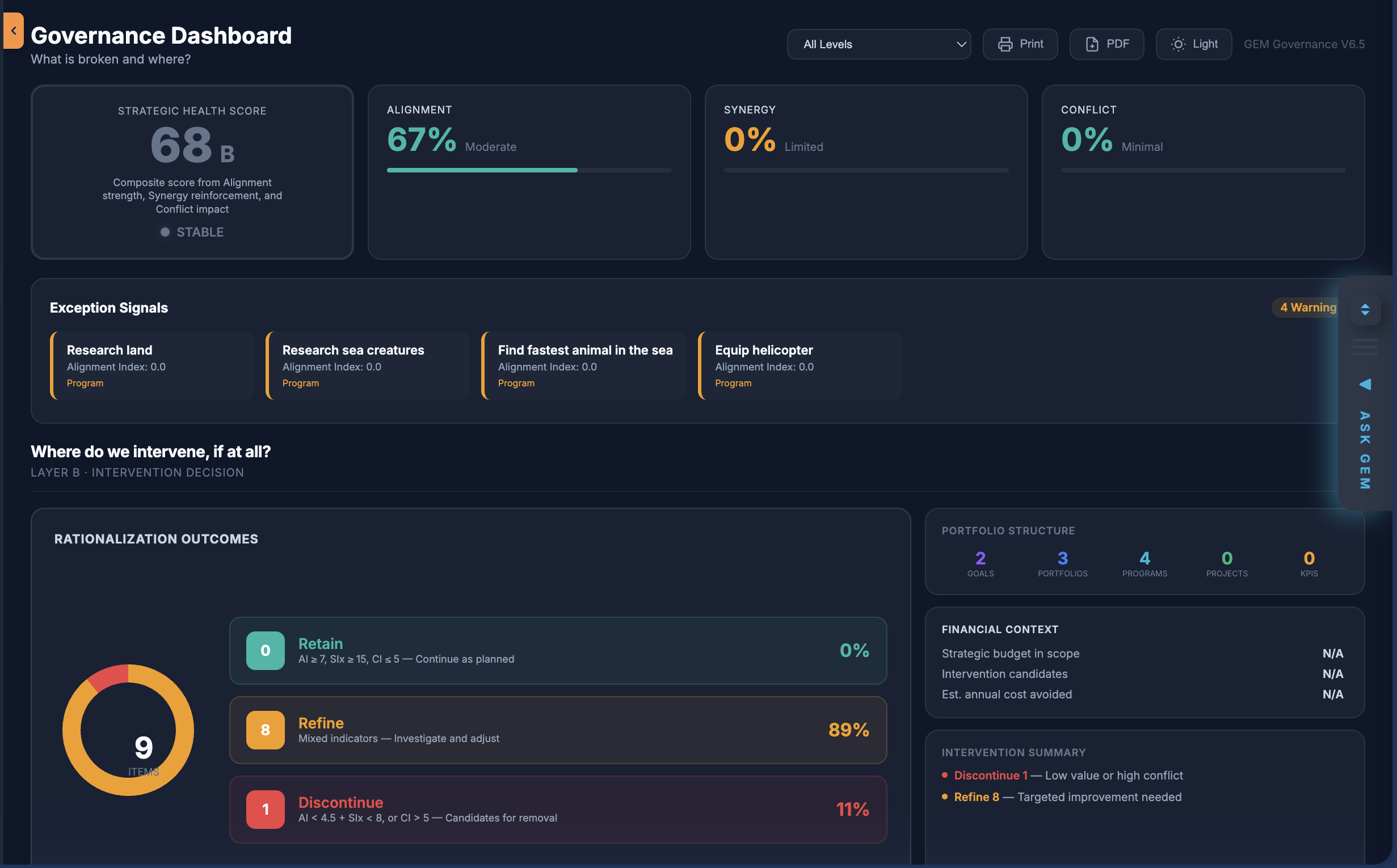
SAF designs and operates institutional execution architectures, supported by a proprietary execution system that sustains alignment, governance discipline, and execution predictability continuously, not episodically.
SAF International maintains institutional affiliations that reinforce our commitment to governance discipline, strategy execution rigor, and executive leadership development.
A global financial institution operating across retail banking, commercial lending, asset management, and digital transformation faced growing execution instability — despite board-approved strategy and active capital deployment.
Leadership identified a critical issue: performance volatility was not a strategy problem. It was a governance problem.
Cross-division conflicts
Initiatives across business lines competed for shared resources without enterprise visibility
Resource contention
Shared functions simultaneously engaged across conflicting transformation streams
Timeline extensions
Delivery milestones shifted incrementally — each defensible, cumulatively damaging
Executive forums unable to prioritize effectively without cross-portfolio visibility
Execution drift
Alignment became assumed rather than demonstrated — governance became narrative
Strategy Execution Breakdown
Five Systemic Weaknesses in the Execution Layer
Enterprise review revealed that execution instability was not the result of poor strategy or insufficient funding. It was the result of structural governance failures that had accumulated across the execution layer — each individually defensible, collectively corrosive.
Governance forums had drifted from decision-making to status reporting. Portfolio growth had outpaced rationalization discipline. Execution drift accumulated gradually, not dramatically.
Figure 1 — Enterprise Execution Breakdown: Five Systemic Weaknesses
Governance review revealed compounding structural failures across the enterprise execution layer
Governance & Execution Intervention
Restoring Disciplined Governance at Enterprise Scale
Intervention Priorities
Measurable linkage between enterprise objectives and active initiatives
Unified cross-division portfolio visibility established
Duplication and sequencing conflicts identified and resolved
Interdependencies mapped and monitored at enterprise scale
Escalation authority and decision thresholds clarified
Execution Intelligence Support
Continuous alignment validation across the portfolio
Cross-portfolio coherence analysis and monitoring
Dependency exposure visibility and alerting
Rationalization discipline for initiative continuation
Standardized executive reporting with decision integrity
Figure 2 — Governance Intervention Architecture
The five-layer intervention structure that restored enterprise execution discipline
Figure 3 — Governance State: Before and After Intervention
The structural shift from descriptive governance to disciplined execution oversight
Governed Outcomes
From Reactive Adjustment to Governed Discipline
Within successive governance cycles, the enterprise portfolio was restructured through disciplined rationalization. Performance volatility declined not because conditions became easier — but because governance became capable of managing complexity.
Execution performance across five dimensions following governance intervention
Executive Lessons
Enterprise performance stabilizes when execution integrity is restored at scale.
Enterprise strategy execution requires more than approval and funding. It requires a governance infrastructure that continuously validates alignment, governs dependencies, and enforces rationalization discipline across the full portfolio.
When execution integrity is restored, strategy becomes credible — not because ambition increases, but because the governance conditions for sustained performance are finally in place.
Strategy becomes credible only when execution becomes governable.