Program Governance and Oversight
Executive Overview
Strategic programs are where enterprise ambition
meets operational complexity

Without structured governance, large programs drift — not because of intent, but because of fragmented accountability, unclear decision rights, and inconsistent performance oversight.

SAF deploys a proprietary software-based execution system to structure, govern, and oversee complex programs through measurable alignment, disciplined oversight, and continuous execution monitoring.

Program Governance ensures that large-scale initiatives remain coherent, accountable, and predictable throughout their lifecycle.

Programs stop being heroic efforts.

They become governed systems.

01 — Service

Program Architecture &
Accountability Design

Program Governance begins with defining the structural foundation of the program. The objective is not to add bureaucracy — it is to remove ambiguity.

Clarifying program scope relative to strategic objectives

Defining sponsorship, ownership, and accountability structure

Establishing governance forums and escalation pathways

Aligning program milestones to measurable strategic outcomes

Structuring visibility across interdependent workstreams

Outcome

Program structure is formalized before execution accelerates.

Program Architecture
Cross-Functional Coordination
02 — Service

Cross-Functional Coordination
& Oversight

Strategic programs span multiple business units and functional domains. Governance ensures coherence across every layer — vertically to strategy, horizontally across functions.

01
Structured coordination between workstreams
02
Executive review cadence tied to strategic impact
03
Dependency tracking across teams and vendors
04
Early detection of execution fragility and scope drift
03 — Service

Risk, Dependency &
Escalation Discipline

Large programs fail quietly before they fail publicly. Program Governance embeds structured risk visibility and escalation discipline throughout the program lifecycle.

Mapping interdependencies between initiatives

Identifying bottlenecks and execution chokepoints

Establishing escalation thresholds

Monitoring performance variance against defined milestones

Ensuring corrective action is governed, not improvised

Outcome

Risk becomes visible early. Escalation becomes structured. Execution becomes predictable.

Risk and Escalation Discipline
04 — Service

Performance Transparency
& Executive Control

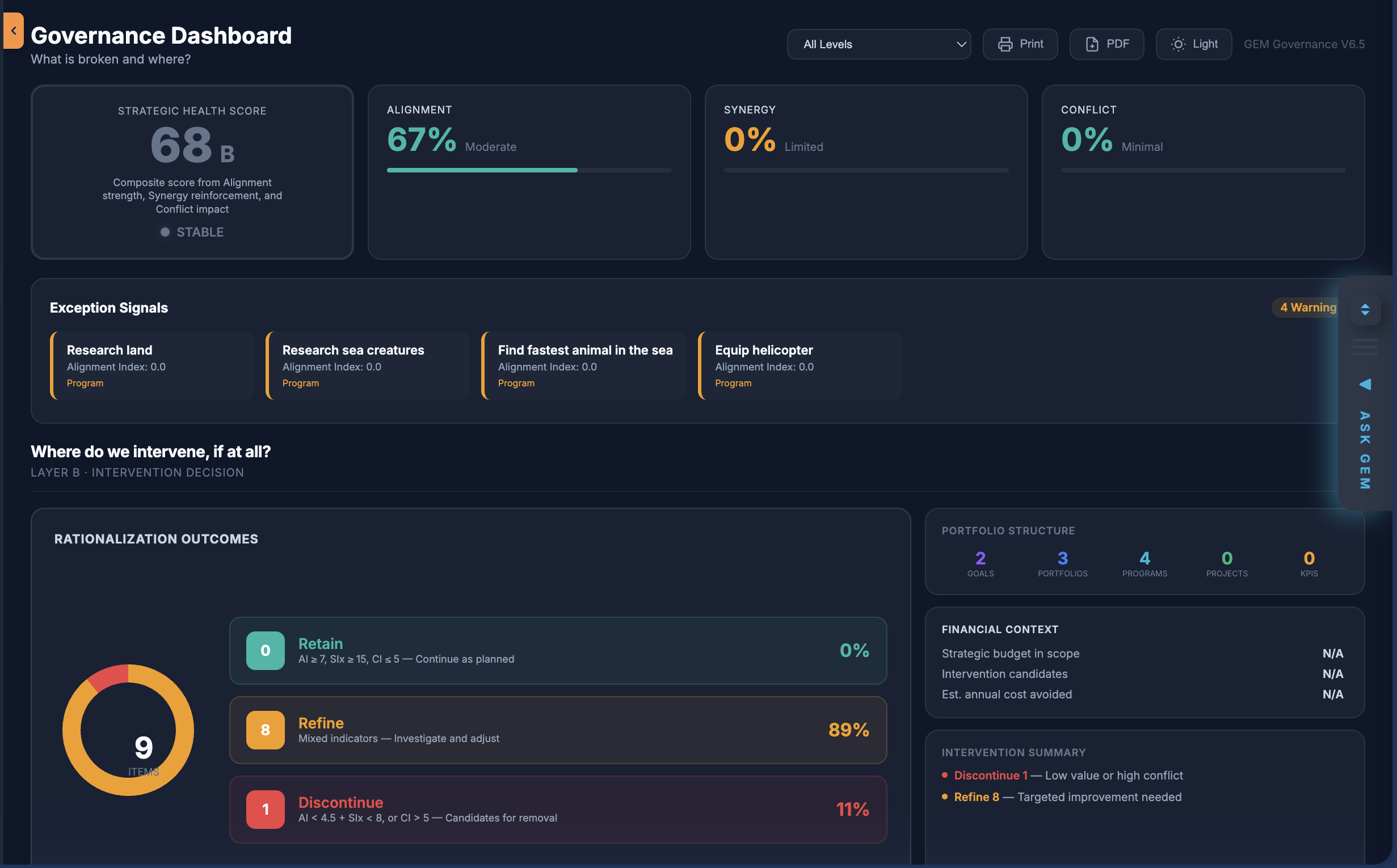
Program Governance institutionalizes reporting discipline across four interconnected pillars — ensuring leadership retains control without micromanaging.

01

Executive
Dashboards

Consistent program health reporting structured for executive-level decision-making across governance cycles.

Programs operate with transparency — not narrative convenience.

02

Alignment
Monitoring

Continuous tracking of program progress against declared strategic intent as conditions and priorities evolve.

Drift is detected structurally before it becomes performance failure.

03

Milestone
Visibility

Clear, structured visibility into milestone progress with documented accountability across workstream owners.

Every milestone has an owner, a status, and a governance record.

04

Decision
Logic

Documented rationale for scope and funding adjustments with structured communication between program leadership and sponsors.

Every significant program decision is traceable and defensible.

05 — Results

Predictable Program
Outcomes

Structured program governance produces measurable improvement across five dimensions of execution reliability.

Reduced cross-functional friction

Improved milestone reliability

Clear accountability across workstreams

Reduced scope drift

Greater confidence in transformation timelines

Programs move from fragile coordination efforts to governed execution systems.

Institutionalize Program
Governance Discipline

SAF structures, governs, and oversees complex programs — ensuring that large-scale initiatives remain coherent, accountable, and predictable from initiation through delivery.