Strategy Execution Audit
Enterprise Strategy

Strategy Execution
Audit

Independent structural assessment of how strategy is currently executed across enterprise, regional, or departmental environments.

Strategy Rarely Fails
Because It Was Poorly Written

It fails because execution is structurally misaligned, governance is inconsistent, and performance reporting does not reflect operational reality.

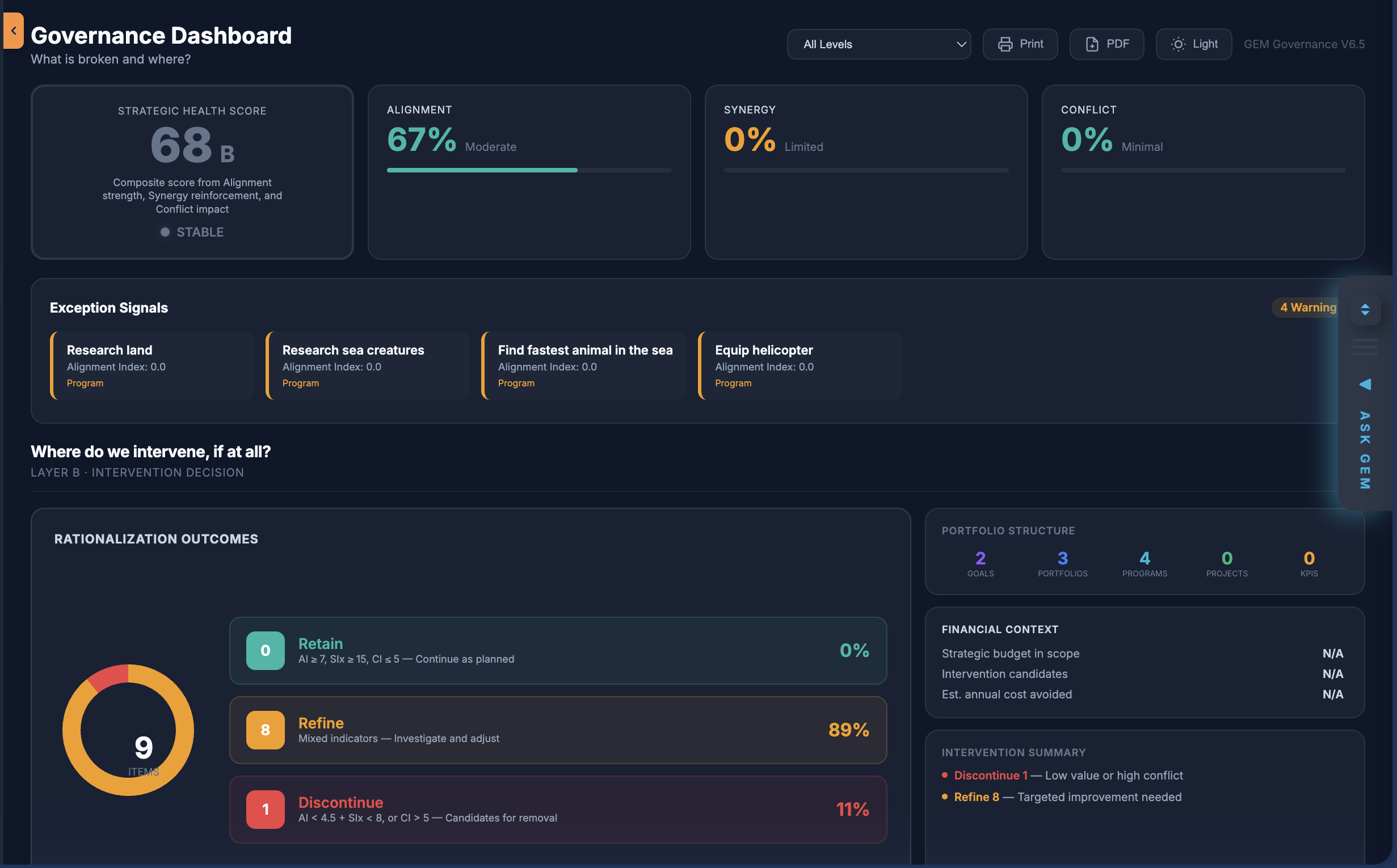
The Strategy Execution Audit is an independent structural diagnostic of how strategy is currently executed. SAF deploys its proprietary software-based execution system to evaluate execution architecture, governance discipline, portfolio coherence, and risk exposure across the relevant scope.

This audit does not produce another strategy deck.

It produces a clear, defensible assessment of execution integrity.

What We Assess

Five Structural Domains

Execution System Setup, Governance Structure, Portfolio Coherence, Execution Risk, and Reporting Integrity.

Methodology

Five-Phase Review Model

Structural Discovery through to full Diagnostic using SAF's proprietary execution system.

Output

Structural Execution Integrity Report

Governance Gap Analysis, Portfolio Coherence Overview, Risk Exposure Map, and Executive Briefing.

Engagement Model

Diagnostic First — No Presumed Implementation

The audit provides structural visibility. Implementation is a separate, optional decision.

What We Assess

The audit evaluates five structural domains — each targeting a distinct layer of execution integrity across the organization.

01

Execution System
Setup Review

We examine whether a structured execution architecture exists and whether it functions coherently.

  • Linkage between strategic objectives and funded initiatives
  • Structural mapping of portfolios, programs, and projects
  • Defined ownership across execution layers
  • Visibility across initiative hierarchies
  • Evidence of alignment discipline rather than assumed alignment

We determine whether execution architecture is institutionalized or improvised.

02

Governance Structure
Assessment

We assess how governance operates in practice, not on paper.

  • Decision-right clarity
  • Executive review cadence
  • Escalation pathways
  • Accountability diffusion
  • Leadership alignment across functions

We identify whether governance is structured and sustained, or episodic and reactive.

03

Portfolio Coherence
Review

Execution fragmentation often occurs horizontally. We examine the full portfolio for structural integrity.

  • Duplication across initiatives
  • Competing priorities across divisions or departments
  • Capital allocation misalignment
  • Initiatives that dilute declared strategy
  • Absence of rationalization discipline

This reveals whether portfolio decisions are structurally defensible or politically influenced.

04

Execution Risk &
Dependency Exposure

We analyze structural fragility within the execution environment before performance degradation occurs.

  • Cross-initiative dependencies
  • Bottleneck concentration
  • Vulnerable execution chains
  • Orphan initiatives without strategic anchor
  • Competing resource demands

Early identification of structural execution risk before performance degradation occurs.

05

Reporting & Transparency
Integrity

We evaluate whether reporting reflects structural reality — not narrative convenience.

  • Traceability between goals and performance indicators
  • Executive dashboard integrity
  • Consistency of metrics across governance cycles
  • Visibility suitable for board-level scrutiny
  • Evidence-based decision logic

We distinguish between narrative reporting and structural governance.

Audit Methodology
Audit Methodology

A Disciplined
Review Model

Five structured phases — from document review through to structural diagnostic — producing objective insight without requiring full system deployment.

The Strategy Execution
Audit Process

The audit follows a disciplined review model that produces objective structural insight across all five domains.

1

Structural Discovery

Document review of strategy materials, governance artifacts, portfolio listings, and reporting structures.

2

Governance Mapping

Mapping of execution layers, ownership structure, and decision cadence across the organization.

3

Portfolio Sampling

Targeted review of representative initiatives to assess alignment, coherence, and governance application.

4

Leadership Interviews

Structured discussions with executive and operational leaders to validate governance in practice.

5

Structural Diagnostic

Evaluation using SAF's proprietary execution system to assess alignment integrity, coherence, and structural risk exposure.

Audit Methodology Process

What the Organization
Receives

Upon completion, the organization receives a structured set of deliverables designed for executive and board-level discussion.

The output is clear, structured, and defensible.

Structural Execution Integrity Report

Comprehensive assessment of execution architecture across all five domains.

Governance Gap Analysis

Identification of governance breakdowns, accountability diffusion, and structural deficiencies.

Portfolio Coherence Overview

Assessment of portfolio alignment, duplication, and capital allocation integrity.

Execution Risk Exposure Map

Structural fragility analysis across initiative dependencies, bottlenecks, and execution chains.

Rationalization Observations

Identified areas of duplication, misalignment, and initiative redundancy.

Executive Briefing Summary

Board-suitable summary suitable for governance committee or leadership review.

When the Audit
Is Appropriate

The Strategy Execution Audit is the right intervention when execution outcomes diverge from strategic intent.

Strategy has been approved but execution outcomes are inconsistent

Portfolio sprawl is evident

Capital allocation appears misaligned

Governance feels reactive rather than structured

Leadership alignment is unclear

The organization is preparing for transformation

The board is demanding execution transparency

Three Possible
Directions

The audit may conclude in one of three structured directions — or the organization may retain the report as a standalone diagnostic reference.

Direction 01

Strategy Execution System Setup

Direction 02

Strategy Implementation Governance

Direction 03

Fully Managed Strategy Execution

The audit does not presume implementation. It provides structural visibility first.

Before Redesigning Strategy,
Assess Execution Integrity

If execution discipline is not measurable, it cannot be governed.

The Strategy Execution Audit provides structural visibility before structural redesign.