Executive Case Brief
Execution Focus
Cross-division discipline and dependency stabilization
A diversified enterprise operating across multiple autonomous divisions faced increasing instability in its execution environment. Each division maintained independent strategy roadmaps, initiative pipelines, and governance forums.
Divisional autonomy had matured. Enterprise coordination had not. The gap between the two was where execution risk accumulated — silently, at the seams between divisions.
At the enterprise level, strategy was declared and capital allocated. Yet cross-division initiatives overlapped, shared services were overextended, technology investments conflicted, and escalation authority was unclear at the boundaries that mattered most.
Strategy Execution Breakdown
Enterprise review identified that the execution fractures were not within divisions — they were between them. Each division operated with reasonable internal discipline. The enterprise lacked the coordination layer to manage what existed at the boundaries.
Portfolio Fractures
Weak visibility into cross-division initiative overlap
Portfolio reprioritization occurring independently within divisions
No enterprise-level rationalization discipline
Dependency Fractures
No unified view of enterprise-wide dependencies
Shared resource contention not visible across divisions
Technology investment conflicts unresolved at enterprise
Authority Fractures
Escalation thresholds defined locally, not enterprise-wide
Inconsistent reporting standards across divisions
Governance forums reviewed divisions in isolation
Divisions believed they were aligned. The enterprise lacked the visibility to know whether they were.
Figure 1 — Where Execution Risk Accumulates: The Division Seam Failure Map
Execution risk does not reside within divisions — it accumulates at the boundaries between them
Governance & Execution Intervention
Execution Intelligence System — Enterprise Capabilities Enabled
Figure 2 — Recovery Architecture: Enterprise Oversight Without Centralisation
Divisional autonomy preserved — enterprise coordination layer reinstated above divisions
Figure 3 — Governance State Transformation: Before and After Recovery
Five dimensions of enterprise governance — from fragmented autonomy to disciplined coordination
Governed Outcomes
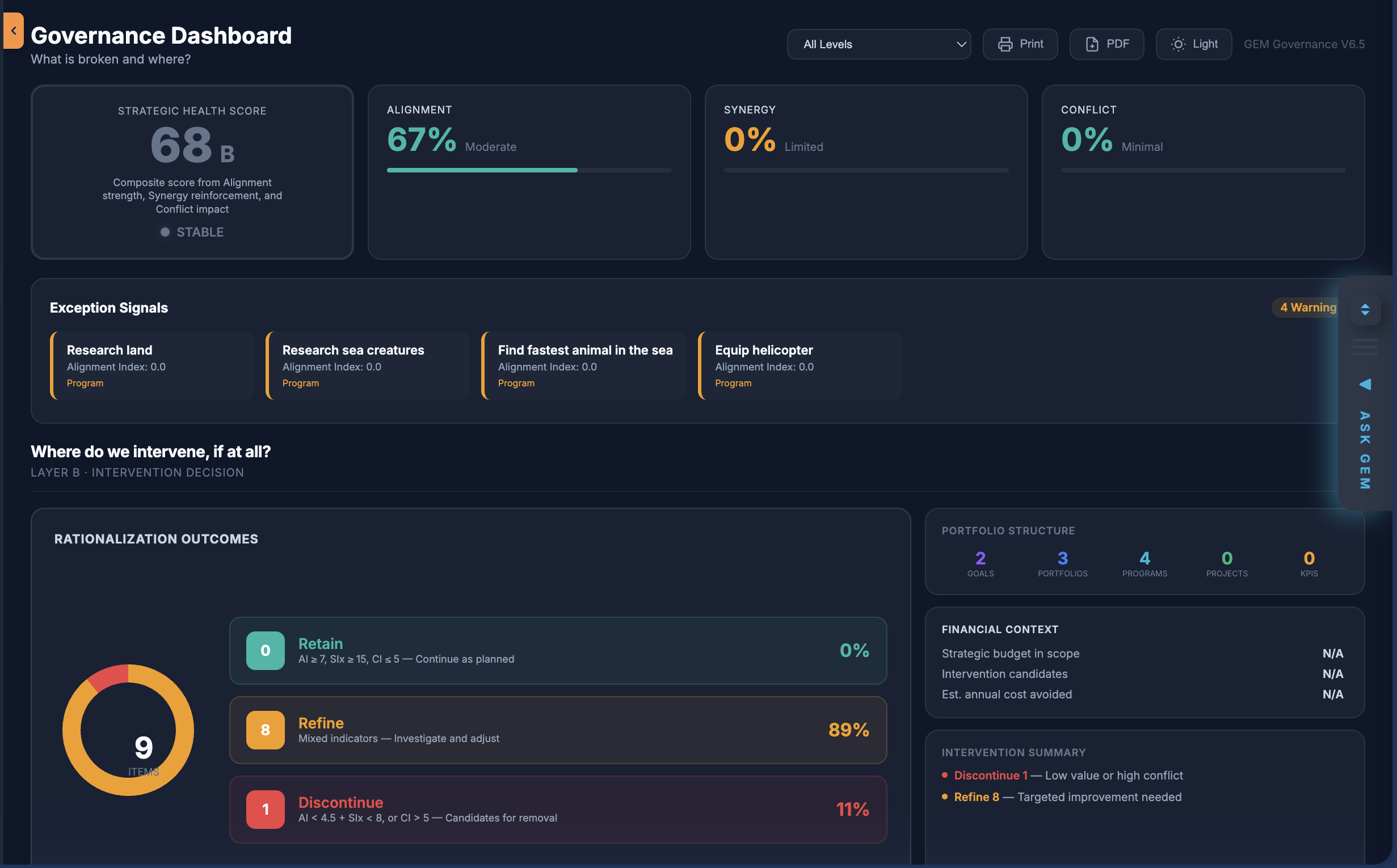
Cross-division overlap identified and consolidated — capital redeployed to underfunded priorities
Conflicting programmes re-sequenced at enterprise level — dependency conflicts resolved
Resource exposure mapped and governed — shared services allocation prioritised by enterprise contribution
Consistent executive visibility established — decision-enabling information replacing narrative updates
Inter-division conflicts resolved at enterprise rather than deferred — decision speed improved
As oversight matured, performance predictability increased — governance moved from reactive to anticipatory
Autonomy is not the problem. The absence of a governance layer above it is. Execution discipline must operate across boundaries — not only within them.
When enterprise oversight is restored without eliminating divisional independence, performance improves because governance finally addresses the layer where execution risk actually accumulates.
Divisional independence without enterprise visibility creates coherence failure — not at the division level, but between divisions
Dependency exposure and initiative overlap are invisible at divisional level — only an enterprise view reveals what is actually at risk
Escalation authority defined locally cannot resolve inter-division conflicts — enterprise-level thresholds are essential
Divisions can believe they are aligned while the enterprise deteriorates — validation requires a view that no single division possesses
Rationalization discipline confined to divisions perpetuates duplication — coherence requires enterprise-level continuation criteria
Enterprise oversight and divisional autonomy are not opposites — disciplined coordination above divisions preserves independence below
Enterprise strategy remains credible only when oversight extends beyond divisional silos.
← Return to Case Studies