SAF designs and operates institutional execution architectures, supported by a proprietary execution system that sustains alignment, governance discipline, and execution predictability continuously, not episodically.
SAF International maintains institutional affiliations that reinforce our commitment to governance discipline, strategy execution rigor, and executive leadership development.
Visibility does not equal control. Most organizations mistake the appearance of governance for its structural reality.
Definition
Reporting theater is the organizational condition in which dashboards, status summaries, and review cadences create the appearance of governance without providing structural control — occurring when visibility is mistaken for authority, and reporting activity substitutes for the measurable oversight required to detect misalignment, enforce rationalization, and keep strategy executable.
Executive Summary
Many organizations mistake reporting activity for governance discipline.
They produce dashboards. They circulate status summaries. They hold review meetings. But visibility does not equal control.
Governance fails when reporting replaces measurable oversight.
Reporting theater is governance failure in disguise — the appearance of oversight without structural control, created through accumulated substitution of presentation for authority
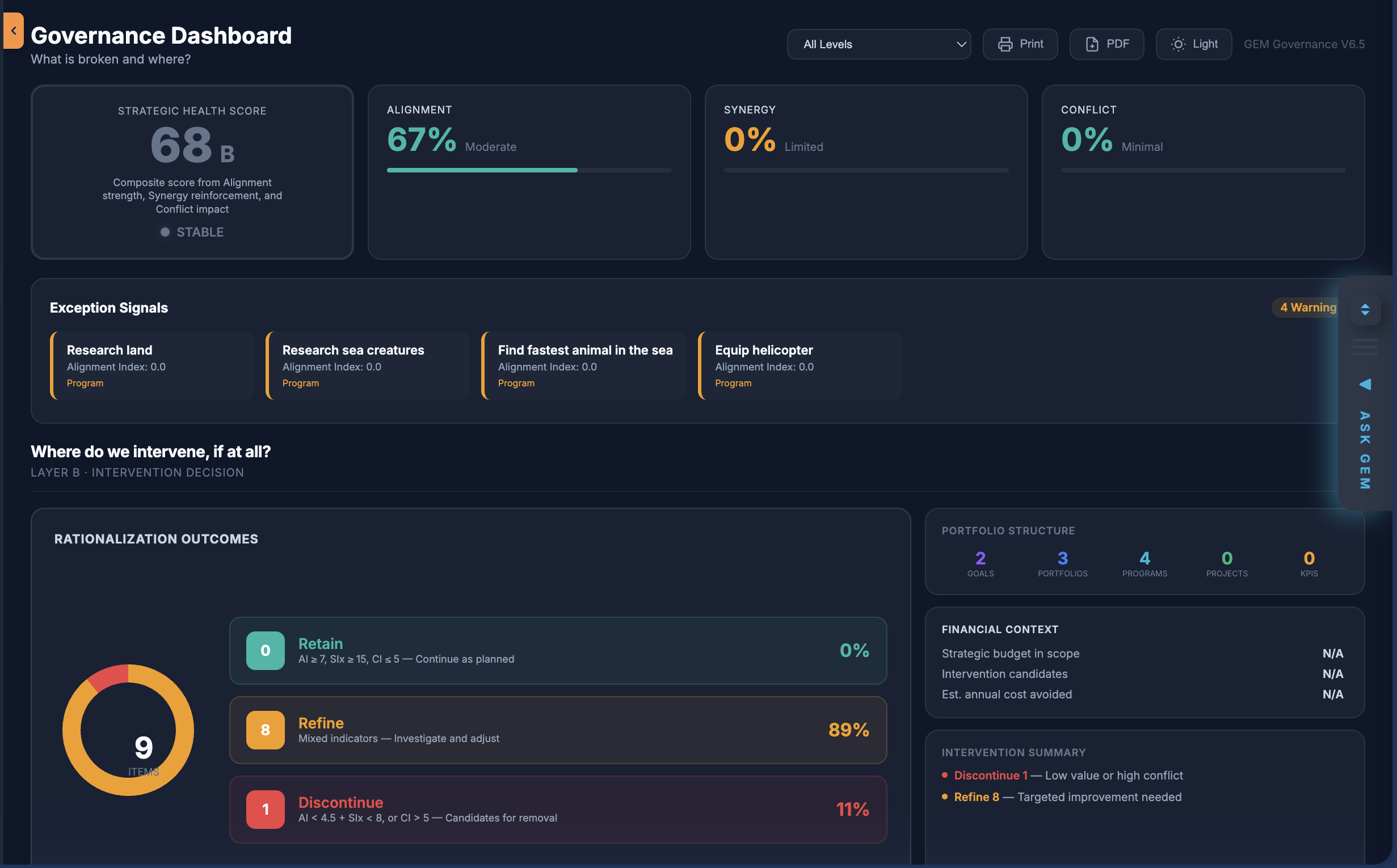
Dashboards answer operational questions — governance requires different ones — whether initiatives still contribute to declared objectives is a question dashboards cannot answer
Alignment is not reference — it is measurable contribution — initiatives that mention goals without demonstrating linkage create an alignment gap that widens invisibly
Governance discipline requires three structural conditions — misalignment detection, rationalization authority, and documented decision logic with traceable accountability
Only governance controls — reporting informs — organizations that conflate awareness with authority lose strategic control while producing evidence that everything is on track
01
The Problem
The Rise of Reporting Theater
Reporting theater is not a deliberate choice — it is the gradual displacement of governance authority by reporting activity, until the organization appears informed but lacks structural control.
Reporting theater emerges gradually — not through deliberate choice, but through the accumulated substitution of presentation for governance. The organization appears informed.
Status replaces alignment validation
Progress metrics lack strategic linkage
Meetings review updates rather than coherence
Dashboards track activity but not contribution
Governance forums lack decision authority
The machinery of oversight operates. But execution remains unmanaged.
Figure 1 — The Reporting Theater Spectrum
Where most organizations sit — and what genuine governance looks like
02
The Visibility Gap
Why Dashboards Are Not Governance
Dashboards describe what is happening. Governance controls what happens next. They serve different purposes, require different structures, and cannot substitute for each other.
Dashboards are built to answer operational questions. They do this well. But governance requires a different category of question — one that dashboards are structurally incapable of answering.
The distinction is not technical. It is structural.
Figure 2 — What Dashboards Answer vs What Governance Requires
The visibility gap between reporting activity and governance evidence
Governance requires evidence of coherence — not descriptions of progress. A full panel of green indicators can accompany a portfolio in strategic drift.
SAF International — Governance Discipline Framework
03
Structural Failure
The Alignment Gap
Alignment becomes narrative when initiatives reference goals without demonstrating measurable contribution — and narrative alignment is indistinguishable from misalignment until performance impact confirms the gap.
Without measurable linkage between strategic objectives and funded initiatives, alignment becomes narrative. Initiatives may reference goals. But reference is not contribution.
When contribution is unquantified, prioritization becomes susceptible to forces that have nothing to do with strategy:
Governance must remove subjectivity from portfolio decisions.
Figure 3 — The Alignment Gap: When Reference Replaces Contribution
How initiatives lose strategic linkage without measurable contribution tracking
04
Compounding Consequences
The Hidden Cost of Reporting Theater
The hidden cost of reporting theater is that its consequences compound below the visibility threshold of the very dashboards used to monitor performance — making the problem invisible until it becomes a crisis.
When reporting replaces governance, consequences compound below the visibility threshold of dashboards. Leadership may feel informed — but they lack structural control.
Initiative duplication persists undetected
Conflicting programs continue consuming resources in parallel
Capital allocation becomes reactive rather than disciplined
Execution drift accumulates without triggering escalation
Decision logic remains undocumented and unreviewable
Figure 4 — Hidden Cost of Reporting Theater Across Governance Dimensions
Impact severity when reporting replaces structural governance
05
The Structural Requirement
Governance Requires Measurable Control
Governance discipline is not more reporting — it is the structural capacity to detect what reporting cannot show, enforce what reporting cannot require, and document what reporting cannot prove.
True governance discipline is not defined by the volume of reporting. It is defined by the structural capacity to detect misalignment, enforce rationalization, and document decision authority.
Visibility into how initiatives support strategic objectives — measurably, not narratively
Cross-initiative coherence assessment across the full portfolio
Dependency and risk exposure mapping with escalation thresholds
Rationalization logic for portfolio pruning, documented and reviewable
Continuous monitoring of drift against declared strategic intent
Governance must be evidence-based — not presentation-based.
If leadership cannot prove why initiatives exist, how they contribute, and where risk resides — governance is performative. Execution integrity requires measurable oversight.
SAF International — Executive Governance Advisory
06
Executive Takeaway
Governance Is Defined by Decision Logic
Governance is defined by decision logic — the ability to answer, with evidence, why each initiative exists, how it contributes to declared objectives, and where risk resides in the portfolio.
Governance discipline is not defined by the quality of slides. It is defined by the clarity of decision logic — the demonstrable answer to why each initiative exists, how it contributes, and where risk resides.
Without this, reporting becomes theater. And theater does not govern execution.
In Summary
Reporting theater is governance failure made invisible — dashboards, status updates, and review meetings create the appearance of control without providing the structural authority to enforce it.
Visibility does not equal control — governance discipline requires the capacity to detect misalignment quantitatively, enforce rationalization with authority, and document decision logic traceably.
Alignment must be measurable, not narrative — initiatives that reference strategic goals without demonstrating contribution create an alignment gap that widens below the threshold of reporting visibility.
Only structural governance keeps strategy executable — organizations that conflate awareness with authority lose the capacity to correct before performance impact confirms what governance discipline would have surfaced earlier.
Reporting informs. Governance controls. Only one determines performance.
Organizations that conflate visibility with control operate under the assumption that awareness substitutes for authority. It does not. Structural governance discipline is the only mechanism that keeps strategy executable.