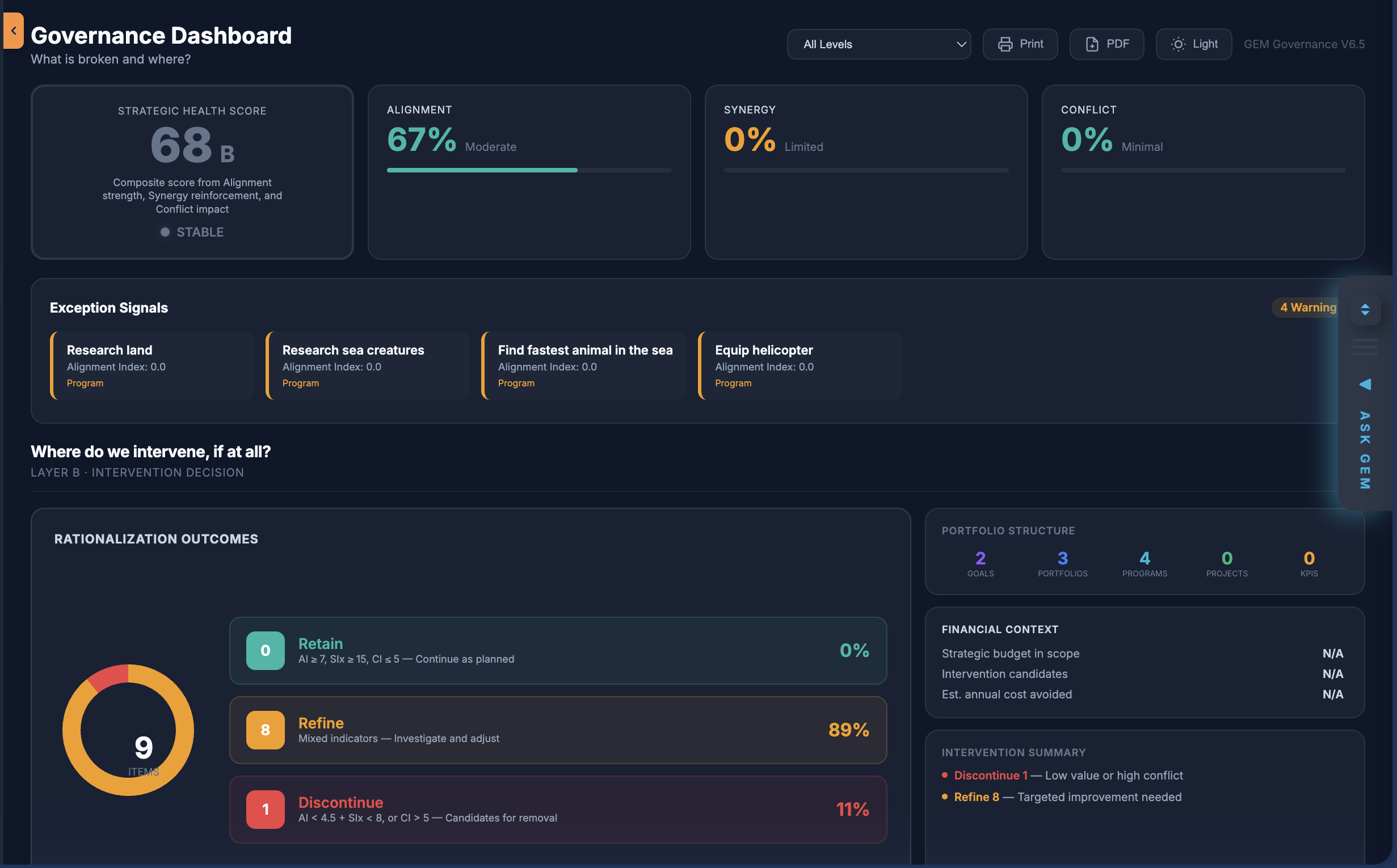
SAF designs and operates institutional execution architectures, supported by a proprietary execution system that sustains alignment, governance discipline, and execution predictability continuously, not episodically.
SAF International maintains institutional affiliations that reinforce our commitment to governance discipline, strategy execution rigor, and executive leadership development.
Recovering Governance Discipline in Multi-Division Enterprises
Definition
Multi-division governance failure is the structural condition in which divisional autonomy operates without an enterprise authority layer capable of enforcing cross-divisional coherence — resulting in overlapping initiatives, conflicting investments, and escalation pathways that can advise but not resolve, until strategic alignment becomes optional and enterprise performance erodes below what any individual division can detect or correct.
What Leadership Observed
Overlapping transformation initiatives across divisions
Conflicting technology investments
Resource contention across shared functions
The Structural Reality
Inconsistent executive reporting standards
Escalation pathways that lacked authority
Each division believed it was aligned
The Enterprise Diagnosis
Coherence deteriorating at enterprise level
Governance forums advisory, not decisive
Alignment had become interpretive
Executive Summary
Multi-division enterprises fail not from lack of strategy but from lack of enterprise execution authority — divisions optimize locally while enterprise coherence erodes
Governance collapses through structural gaps, not dramatic failures — inconsistent reporting, advisory-only escalation, and unvalidated priority translation accumulate silently
Recovery requires shifting from divisional review to enterprise coherence evaluation — the question changes from whether each division is performing to whether the enterprise is coherent
Divisional autonomy is preserved through governed boundaries, not eliminated — enterprise governance sets the coherence boundary within which divisions retain full operational authority
Governance authority must be structural, not positional — forums that can only advise cannot resolve the conflicts that erode enterprise alignment
Multi-Division Enterprises Rarely Suffer from Lack of Strategy
The multi-division governance problem is not strategic — it is structural. Without enterprise-level execution authority, divisional coherence substitutes for enterprise alignment, and the gap between the two widens invisibly.
They suffer from fragmented execution authority. Each division interprets priorities independently. Initiatives multiply. Coordination weakens. Governance forums become advisory rather than decisive.
Governance discipline erodes gradually — until alignment becomes optional. Recovery requires restoring decision clarity, not increasing reporting volume.
The Breakdown
How Enterprise Governance Collapsed
Enterprise governance does not collapse through a single event — it erodes through the accumulation of structural gaps that each appear manageable in isolation but combine to make coherence impossible.
Governance discipline collapsed not through dramatic failure but through the quiet accumulation of structural gaps — each individually defensible, collectively corrosive.
Strategic priorities not uniformly translated into funded work
Portfolio visibility did not extend across divisions
Dependencies managed locally, not systemically
Executive reporting varied by business unit — no consistent enterprise signal
The enterprise lacked unified execution oversight. Alignment became interpretive — each division claiming coherence, the enterprise unable to verify it.
Figure 1 — Before Recovery: Fragmented Authority vs Enterprise Governance
How decentralized interpretation erodes enterprise coherence — and the structural shift required to restore it
Each division believed it was aligned. At the enterprise level, coherence was deteriorating.
The Turning Point
From Divisional Review to Enterprise Coherence
Governance recovery begins with a single structural shift: replacing divisional progress reviews with enterprise coherence evaluation — measuring not whether divisions are performing but whether the portfolio is aligned.
Recovery began when leadership shifted from reviewing divisional progress independently to evaluating enterprise-level coherence. The question was no longer whether each division was performing — it was whether the enterprise was coherent.
Cross-division initiative overlap identified and addressed
Measurable linkage to enterprise objectives required — not assumed
Dependency concentration across shared functions mapped
Capital allocation coherence validated at enterprise level
Clear decision authority established at enterprise level
Alignment was no longer assumed at the divisional level. It was validated at the enterprise level.
Figure 2 — Governance Breakdown: Root Causes and Recovery Actions
Each structural failure in the breakdown phase mapped to its disciplined governance response
Before Recovery
Overlapping initiatives undetected across divisions
Conflicting transformation streams active simultaneously
Inconsistent reporting — no enterprise-level signal
Escalation authority unclear — decisions deferred
Divisional autonomy without enterprise governance boundary
After Recovery
Redundant initiatives consolidated — one workstream per objective
Divisional autonomy maintained within governed enterprise boundary
Outcome Scorecard — Two Governance CyclesResults within 2 review cycles
Action Area
Before
After
Change
Initiative overlap
Undetected
Consolidated
Redundancies removed
Transformation sequencing
Conflicting
Coordinated
Conflict eliminated
Enterprise reporting
Inconsistent
Unified
Single standard
Escalation authority
Unclear
Defined
Decisions landed
Portfolio coherence
Deteriorating
Restored
Measurably improved
Executive Lesson
Multi-Division Enterprises Fail When Enterprise Governance Lacks Clarity
Multi-division governance fails not because divisions have autonomy, but because enterprise governance lacks the structural authority to define the boundary within which that autonomy operates.
The failure is not that divisions act independently. Divisional autonomy is structurally appropriate — and, in the recovery, it was preserved. The failure is when enterprise governance lacks the authority to set and enforce the boundary within which that autonomy operates.
Governance discipline must operate above divisional boundaries. Execution integrity depends on unified oversight. And alignment — real alignment, not narrative alignment — requires enterprise authority that is decisive, not advisory.
In Summary
Multi-division enterprises fail from execution authority gaps, not strategy gaps — the absence of governance above the divisional level allows coherence to erode while each division believes it is aligned.
Governance collapses through structural accumulation — advisory escalation paths, inconsistent reporting, and unvalidated priority translation compound silently until performance impact becomes visible.
Recovery requires enterprise coherence evaluation, not divisional performance review — the governance question shifts from how each division is performing to whether the enterprise portfolio is coherent.
Governance authority must be structural to be effective — forums that can only advise cannot resolve the cross-divisional conflicts that erode strategic alignment at the enterprise level.