


Executive Summary
In regulated financial institutions, execution failure is not operational inconvenience. It is regulatory exposure, capital erosion, and reputational risk.
Strategy execution must withstand supervisory scrutiny, capital pressure, and cross-division complexity. Alignment must be demonstrable.
Execution integrity defines institutional credibility. Governance gaps and execution gaps are the same thing viewed from different angles.
- Execution failure in regulated institutions is regulatory exposure — governance gaps and execution gaps are the same thing viewed from different supervisory angles
- Alignment must be demonstrable, not declared — supervisors expect traceable linkage from strategy to funded execution at every governance layer
- Capital decisions must be defensible under scrutiny — allocation logic that cannot demonstrate measurable contribution creates regulatory vulnerability
- Multi-division complexity compounds without enterprise governance authority — each division nominally aligned while enterprise coherence erodes
- Execution volatility must be governed, not absorbed — regulatory, market, and competitive pressure requires dependency governance that prevents compounding failures
01 — The Constraint
The Regulatory Constraint
In regulated financial institutions, governance is not an internal discipline — it is an externally verified obligation. Execution decisions must produce evidence of alignment, not just assertions of intent.
Financial institutions operate within layered regulatory environments that demand accountability at every level of the execution chain. Supervisory bodies expect clear evidence — not assertion — of governance discipline.
- Clear linkage between strategic priorities and funded initiatives
- Documented capital allocation logic at each decision point
- Defined escalation pathways for execution risk
- Governance visibility across business units and jurisdictions
- Consistent performance reporting across oversight layers
When traceability is weak, regulatory vulnerability increases. Execution gaps are governance gaps — the same structural failure viewed from a different supervisory lens.
Figure 1 — Regulatory Traceability: From Strategic Priority to Supervisory Evidence
The governance chain that supervisors expect — and execution gaps that create regulatory exposure
02 — Capital Discipline
Capital Discipline Under Strategic Pressure
Capital discipline in financial institutions means every major investment must demonstrate measurable contribution to declared priorities — because constrained capital allocated without defensible logic creates simultaneous execution risk and regulatory exposure.
Financial institutions operate under relentless strategic pressure — digital modernization, regulatory remediation, product expansion, post-acquisition integration, cost transformation — all competing for constrained capital simultaneously.
Without disciplined alignment between objectives and investment decisions, portfolios expand without coherence. Capital follows advocacy rather than strategy.
- Funding reflects measurable contribution — not historical momentum
- Portfolio duplication is surfaced before capital dilution occurs
- Conflicting initiatives are identified and resolved at the portfolio level
- Continuation and termination decisions are justified and documented
Capital discipline is an execution mandate — not merely a financial exercise.
Capital allocation must reflect strategic intent — not internal advocacy or legacy momentum.
03 — Portfolio Complexity
Multi-Division Complexity
Multi-division financial institutions face enterprise governance failure at institutional scale — each division nominally aligned, each pursuing separate priorities, and enterprise coherence eroding beneath a compliance architecture that cannot see it.
Large financial institutions operate across retail banking, corporate and commercial banking, asset and wealth management, insurance, and global markets. Each division pursues initiatives aligned — at least nominally — to enterprise objectives.
Without integrated oversight, coherence deteriorates at the intersections. Cross-divisional initiatives frequently:
- Compete for shared technology and change management resources
- Duplicate capability development across business lines
- Introduce conflicting system changes without visibility
- Create hidden interdependencies that amplify delivery risk
Execution governance must extend beyond individual business lines to preserve portfolio integrity at the enterprise level.
Figure 2 — Multi-Division Execution: Where Governance Complexity Compounds
Cross-divisional initiative intersections where coherence most frequently deteriorates
04 — Reporting Integrity
Reporting Integrity Under Supervisory Scrutiny
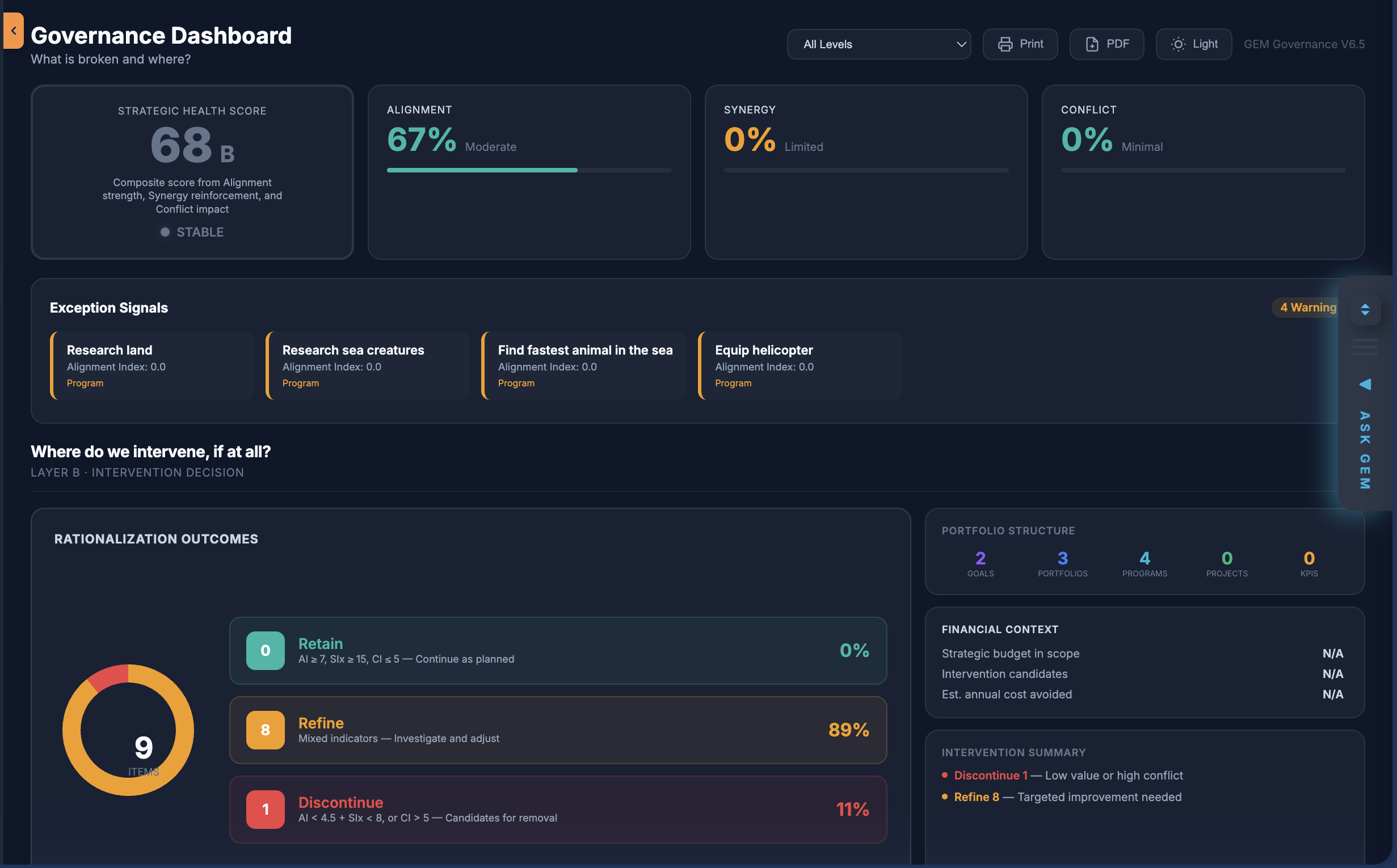
Reporting integrity in financial institutions is not a documentation requirement — it is a governance accountability. Dashboards that track activity without demonstrating strategic contribution fail both boards and regulators.
Boards and regulators require clarity that extends beyond status summaries. Dashboards that describe activity without demonstrating contribution weaken governance authority — and create vulnerability when scrutinized.
- Clear traceability between objectives and initiatives at every level
- Visibility into cross-portfolio interdependencies and risk concentration
- Consistent performance signals across all governance layers
- Documented rationale for every reprioritization decision
When reporting supports decisive governance rather than presentation, institutional confidence strengthens — internally and with supervisors.
05 — Execution Stability
Managing Execution Volatility
Financial institutions cannot eliminate execution volatility — but they can govern it. Dependency management and alignment validation determine whether regulatory, market, and competitive disruptions compound or are contained.
Financial institutions operate under persistent execution volatility driven by forces largely outside their control. Volatility compounds when dependencies are unmanaged and alignment is assumed rather than verified.
Predictability improves when interdependencies are visible, risk concentration areas are identified early, portfolio adjustments follow defined criteria, and alignment is validated continuously — not retrospectively.
Figure 3 — Financial Institution Volatility Drivers vs Governance Stabilizers
Persistent pressures on execution integrity and the structural responses that contain them
- Execution integrity is institutional credibility — in regulated financial institutions, governance gaps and execution gaps are indistinguishable under supervisory scrutiny.
- Alignment must be demonstrable at every layer — from strategy declaration to funded initiative, traceable linkage is the standard supervisors require and boards should demand.
- Capital discipline requires defensible allocation logic — investment decisions justified by measurable contribution rather than political priority withstand the scrutiny that others do not.
- Execution volatility compounds when dependencies go ungoverned — regulatory, market, and competitive disruptions become institutional risk when alignment is assumed rather than continuously validated.
Executive Takeaway
Execution integrity defines institutional credibility.
Alignment must be visible and verifiable at every governance layer
Capital decisions must be justified by measurable contribution
Dependencies must be governed, not discovered after failure
Reporting must support action, not appearance